
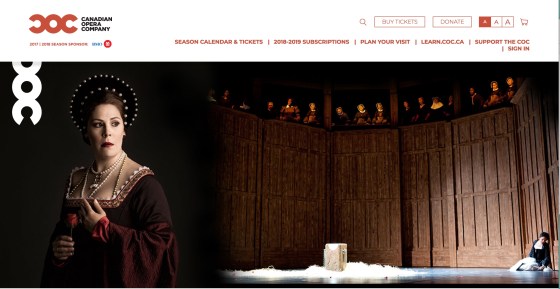
Left: Sondra Radvanovsky in Anna Bolena (Washington Opera, 2012), promotional photo: Cade Martin; A scene from Anna Bolena (WNO, 2012), photo: Scott Suchman.
I was given the gift of a ticket to see tonight’s production of Donizetti’s Anna Bolena performed by The Canadian Opera Company. I cannot begin to describe it but I’m going to try.
I have been attending operas since I was five years old. My parents took me to an English production of The Barber of Seville in the hope that I would fall in love with the art form as much as they had. That night, so long ago, I was filled with wonder and awe and amazement, and felt goose bumps as I saw and heard something more spectacular than I had ever seen or heard before. Since then, I have attended a variety of types and styles and genres performed by a variety of companies and enjoyed the majority of what I have seen. However, tonight when I experienced the COC production of Anna Bolena, I felt all those same feelings that I felt when I saw my first opera. Spectacular seems too mundane a word for this performance.
Gaetano Donizetti’s Anna Bolena is both interesting and intriguing simply in its existence. Like most historical operas it shouldn’t be taken as a history lesson. Many of the “facts” are the result of artistic license. But the libretto gives an impression. The impression is from a Roman Catholic, Italian perspective, and is about the tumultuous English Tudor Court of the king accused of breaking the church–Enrico VIII. For those of us who have been raised with an Anglocentric history education about Henry VIII, this in itself, is fascinating.
Although my parents had a recording of this opera that I frequently heard as a child, and I now have my own recording, I had never seen a performance before tonight. The opera is infrequently performed, I am told because it is so demanding. The three hour story, in two acts, is dependent on the two lead soprano’s and this production’s Sondra Radvanovsky (Anna Bolena) and Keri Alkema (Giovanna Seymour) are a tour de force in their respective roles. The programme notes indicate that the two women are very close friends. It is evident that they use this friendship to reach added emotional depths in the duet of the second act when Giovanna reveals that she is “the other woman”. As each woman’s individual vocal excellence joins with the other, they create a musical interplay that combined with their physical interaction is spellbinding. Alkema truly appears as a woman bereft upon the sudden realisation she is sending her best friend to die; Radvanovsky portrays the trauma of registered betrayal with genuine consternation. Even though at the beginning of the duet it appears that Giovanna is waffling in her desire for the throne, upon receiving Anna’s forgiveness, her physical deportment shows her beginning to regroup and reconsidering her grasp at power.
Other than the duet there are two specific scenes where Radvanovsky’s dramatic abilities, as well as her incredible voice, are particularly entrancing. In Act I there is a short section when she is in front of Enrico and she realises that Enrico is not simply less interested in her, but rather, he has fallen for someone else. She portrays an incredible fragility and uncertainty as she suddenly becomes aware that her whole world is going to come crashing down. Her voice sounds weak and yet it retains it’s clarity and precision. The weakness is the character’s and not the singer’s. The second scene is “the mad scene” near the end of the opera. Donizetti seems to enjoy presenting mad scenes and Radvanovsky’s performance makes Anna’s solo every bit as unnerving as Lucia’s.
Alkema, as Giovanna, too shows off an exquisite vocal capability that reflects a variety of emotions when confronting Enrico. Her pleading that Anna be spared is quite different from her tense but assured interactions with Anna. She is able to vary between insecurity and imperiousness with ease.
Even though these two women drive this opera it would not be the success it is without others in the cast. Christian Van Horn is as close to perfect, in his portrayal of Enrico, as one could hope. I had to think about his performance carefully because I naturally fall in love with the bass. (I’m one of those who’s always cheering for Mephistopheles in Faust and in Jesus Christ Superstar it was Caiaphas and Judas who stole my heart. I don’t think that was the Gospel writer’s intent.) Despite my bias, upon reflection I realise it is the complete package that Van Horn offers that makes his Enrico so amazing. He is the perfect, handsome, “chick magnet” disdainful, arrogant, womanizing, self-centred, powerful, sexist, stylish, athletic creep! His voice oozes megalomania with a quality that makes the hearer quiver. He is an appropriately Machiavellian prince. Van Horn’s Enrico is one you love to hate
Bruce Sledge as Lord Riccardo Percy does an excellent portrayal of the typical weak hero. If he were to take it any further Percy would become a buffoon. Sledge draws the line at just the right point. His voice has a pleading quality when he approaches Anna that clearly indicates his passionate desire while maintaining its clarity and quality. Throughout his performance he professes his love for Anna and at the same time refuses to do the one thing that might keep her safe, he refuses to leave her. Even for those who know the ending of the opera Sledge’s performance offers surprise. He has performed the feeble hero so well that when Riccardo actually does the heroic thing in the end it is a shock. I was most concerned about the portrayal of this role–that the tenor would try to portray him as a true hero rather than as the flawed character he really is. Bruce Sledge delighted me in his portrayal.
Allyson McHardy as Smeton must also be mentioned. Her portrayal of the lovesick young man is extremely sensitive. Normally, when I’ve heard this opera, I’ve thought of Smeton as a necessary incidental. He is important to the plot’s development but it is hard to get a sense of who he is. McHardy in her vocal and physical portrayal gives the character a depth that was enchanting. Here is the young man full of hope and love (really infatuation) while at the same time despondent because he knows his dreams will never be realised. For me, she brought Smeton to life in way that made his death even more tragic.
The cast is well matched because in each of the ensemble sections all voices can be heard both distinctly and as an integrated whole. The performance of the cast is superb. So is the performance of the orchestra under Corrado Rovaris. Too often I have thought of the COC orchestra as too loud for the stage performers, sometimes overpowering them, but this performance strikes the perfect balance.
Was there anything I didn’t like? Yes. I intensely disliked the costumes of Ingeborg Bernerth and the staging was not impressive. Many of my opera loving friends would say, “Who cares when you have voices like those?” However, if I didn’t want to see “a show” I would be satisfied with a concert performance.
The director, Stephen Lawless, describes this opera in his notes:
We remain within the framework of our Globe Theatre setting, now suitably altered to reflect an earlier and darker milieu than the sophistication of Elizabeth I’s reign, a world where entertainment was more about the bear-pit then [sic] the subtleties of Shakespeare’s (as yet unwritten) verse, a world as much influenced by the medieval as by the Renaissance.
He is placing it within the context of the other two Donizetti Tudor operas performed by the COC. Unfortunately, I don’t think what he describes works, especially not in the first act where it is more drab than dark.
Using the Globe theatre as the framework has separated the ensemble from the main characters in a manner that places them in the position of the Greek chorus. They both observe and comment on what is happening and they do not engage as the servants, courtiers, retainers and advisors who are integral to the court and active within it. Even some of the essential minor characters, such as Hervey, went back and forth between the action and the Greek chorus making him more ephemeral than devious. The only time that there seemed to be a bustling court was at the end of Act I when Enrico makes his accusations and the supporters of Anna respond. This staging seems very disjointed. As well, at times the movement of the set was “clunky” and distracting as opposed to being enhancing of the performance
In the opening of Act I Anna is waiting for the return of Enrico. She is hoping to save their marriage. She appears in her first costume and it looks drab. Fortunately Radvanovsky’s carriage gives the role a sense of sophistication that was absent in the costume but that is not sufficient. Even within the confines of Romani’s libretto it is clear that the only hope of Anna’s survival as queen (her death is not yet being considered by the text) is to have a male child for Enrico. These events occur in an era before IVF. There is only one way the goal could be accomplished. Looking drab is not the way for Anna to achieve success. The only really glamorous costume was in a very cheesy moment when Enrico is dressed in the outfit of the Hans Holbein painting and strikes the pose. (Yes, I know it was during Seymour’s time that his painting was done but it’s just kitchy.) I believe it is no longer artistry when sets and costumes are removed from the plot and actually work counter to the plot. The performances of the cast however were so superb that the appearance of the stage could usually be ignored.
If you live within eight hours of Toronto and the COC, and if you can get tickets, take the time to see this performance. Even if it is the only show/concert/ recital you can afford this year. I imagine it will be another 60+ years before I will see another operatic performance that moves me so.
I started by saying “I haven’t got the words…” and yet I have used so many to describe the experience I had with Anna Bolena. The difficulty in finding one word that does justice to describe the evening is why there are so many. Anna… Brava!
 Mundane Musings